

Last Updated: November 12, 2026
Quick Summary
The best electrolyte powder without artificial sweeteners is sweetened with stevia and erythritol rather than sucralose, aspartame or acesulfame K. HYCO's range, including the £27.00 Taster Pack and £49.00 Double Pouch, uses stevia and erythritol with no sugar, calories or caffeine. If you want zero sweeteners of any kind, choose an unsweetened, unflavoured powder and accept the salty taste.
- Check the ingredients list for sucralose, aspartame, acesulfame K and saccharin, which are artificial sweeteners.
- Stevia and erythritol are not artificial, so a stevia-sweetened powder clears an artificial-sweetener-free bar.
- The HYCO Taster Pack gives ten Mixed Berry and ten Tropical sachets for £27.00, ideal for first-time buyers.
- Each HYCO sachet delivers 250mg of sodium and is mixed into 500ml to a litre of still water.
- Unsweetened, unflavoured powder tastes savoury, so mix it into a smoothie or juice rather than water.
Table of Contents
- Why Electrolyte Powder Without Artificial Sweeteners Is Worth the Label Check
- The Best Electrolyte Powder Without Artificial Sweeteners: Quick Comparison
- HYCO Taster Pack: The Sensible First Buy
- HYCO Pouches and Double Pouch: Everyday Value Once You Know Your Flavour
- Electrolyte Powder Without Stevia: What the Unsweetened and Unflavoured Options Actually Taste Like
- Electrolyte Powder With No Sweeteners: How to Read the Ingredients List
- Sugar-Free Electrolyte Powder: Sweetener Types, Calories and Carbohydrates Compared
- Electrolytes Without Sugar: Matching Sodium, Potassium and Magnesium to Your Day
- Frequently Asked Questions
Why Electrolyte Powder Without Artificial Sweeteners Is Worth the Label Check
Walk into any supermarket and you'll find electrolyte powder sachets marketed as "sugar-free" that still contain a sweetener list as long as your arm. That's the trap. "Sugar-free" tells you nothing about what replaced the sugar.
The label deserves more scrutiny than the front of the pack gets. An electrolyte powder is a mix of sodium, potassium, magnesium and other minerals designed to replace what you lose through sweat and daily fluid loss. Some electrolyte powders without artificial sweeteners deliver those minerals with a sweetener you recognise, or none at all.
Why bother? Because you drink this stuff daily. A sweetener you're unsure about, consumed once, is a non-event. Consumed every afternoon for a year, it's worth a two-minute read of the back label. Below, we walk through the options, the sweetener types, and how to match mineral doses to your day.
The Best Electrolyte Powder Without Artificial Sweeteners: Quick Comparison
Here's the short version before the detail. Every option below is sugar-free, and none contains artificial sweeteners.
| Product | Price | Servings | Sweetener | Best For |
|---|---|---|---|---|
| HYCO Taster Pack | £27.00 | 20 | Stevia and erythritol | First-time buyers |
| HYCO Mixed Berry Pouch | £27.00 | 20 | Stevia and erythritol | Daily mixed berry drinkers |
| HYCO Tropical Pouch | £27.00 | 20 | Stevia and erythritol | Daily tropical drinkers |
| HYCO Double Pouch | £49.00 | 40 | Stevia and erythritol | Settled buyers wanting value |
| HYCO Starter Packs | £14.00 | 10 | Stevia and erythritol | Testing one flavour |
| Unsweetened and unflavoured powders | Varies | Varies | None | Purists who add their own flavour |
Servings
HYCO Taster Pack: The Sensible First Buy
If you've never tried an electrolyte powder, buying a 40-serving pouch on day one is a gamble. The Taster Pack solves that. You get ten Mixed Berry and ten Tropical sachets for £27.00, so you can find your flavour before committing.
What You Get in the Box
Every sachet carries the same formula: 250mg of sodium plus potassium, magnesium, calcium, zinc and chromium, alongside vitamins C, D3, B5, B6 and B12. No sugar, no calories, no caffeine. Mix one sachet into 500ml to a litre of still water.
Where It Falls Short
Twenty servings at £27.00 works out pricier per sachet than the Double Pouch. Watch out: if you already know you like berry flavours, skip straight to a pouch and save the difference.
Best for: anyone new to HYCO or new to electrolyte powder generally. Skip if: you've already settled on a flavour.
If that's you, you can find your favourite with the HYCO Taster Pack before choosing a pouch.
HYCO Pouches and Double Pouch: Everyday Value Once You Know Your Flavour
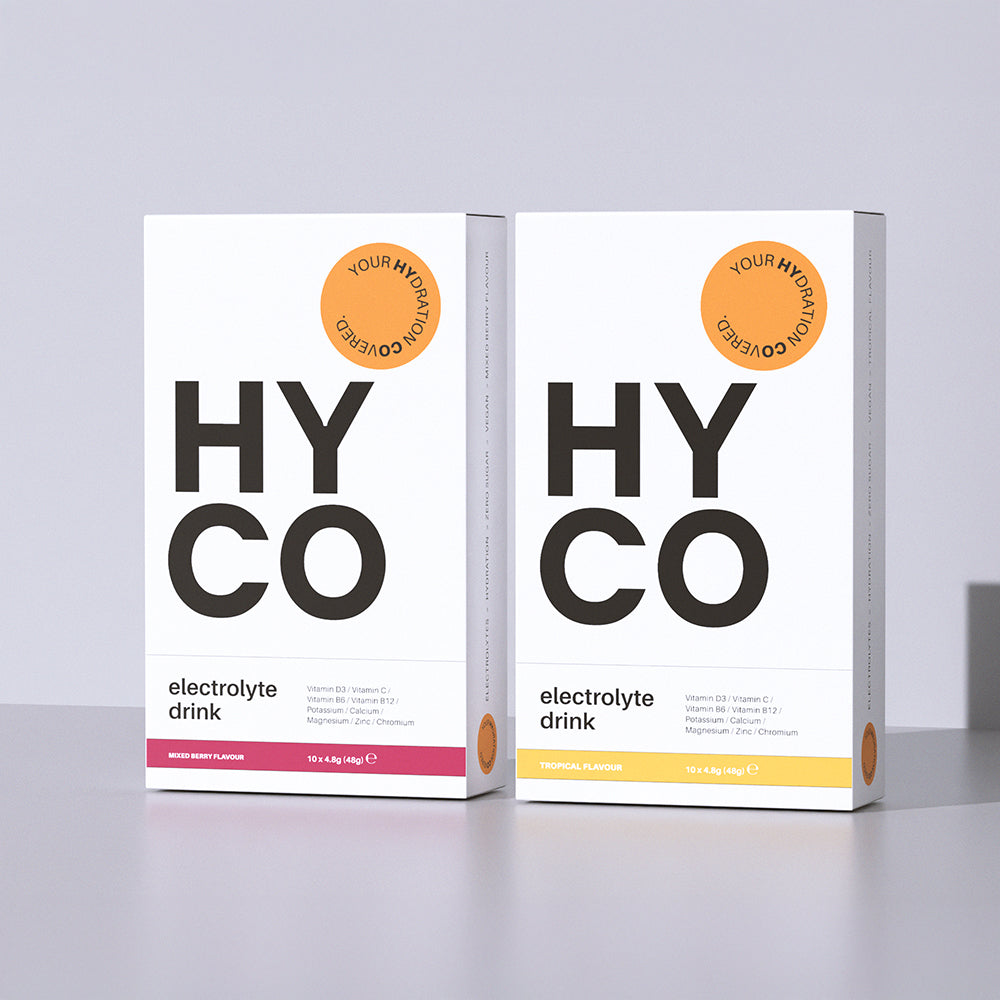
Once flavour is settled, the maths changes. A single pouch gives you twenty sachets for £27.00. The Double Pouch gives you forty for £49.00.
Mixed Berry and Tropical Pouches at £27.00
Both flavours are sweetened with stevia and erythritol, contain no sugar, calories or caffeine, and are vegan and keto friendly. Tropical stays light even mixed at 500ml. Mixed Berry is the softer, more familiar taste of the two.
The Double Pouch at £49.00
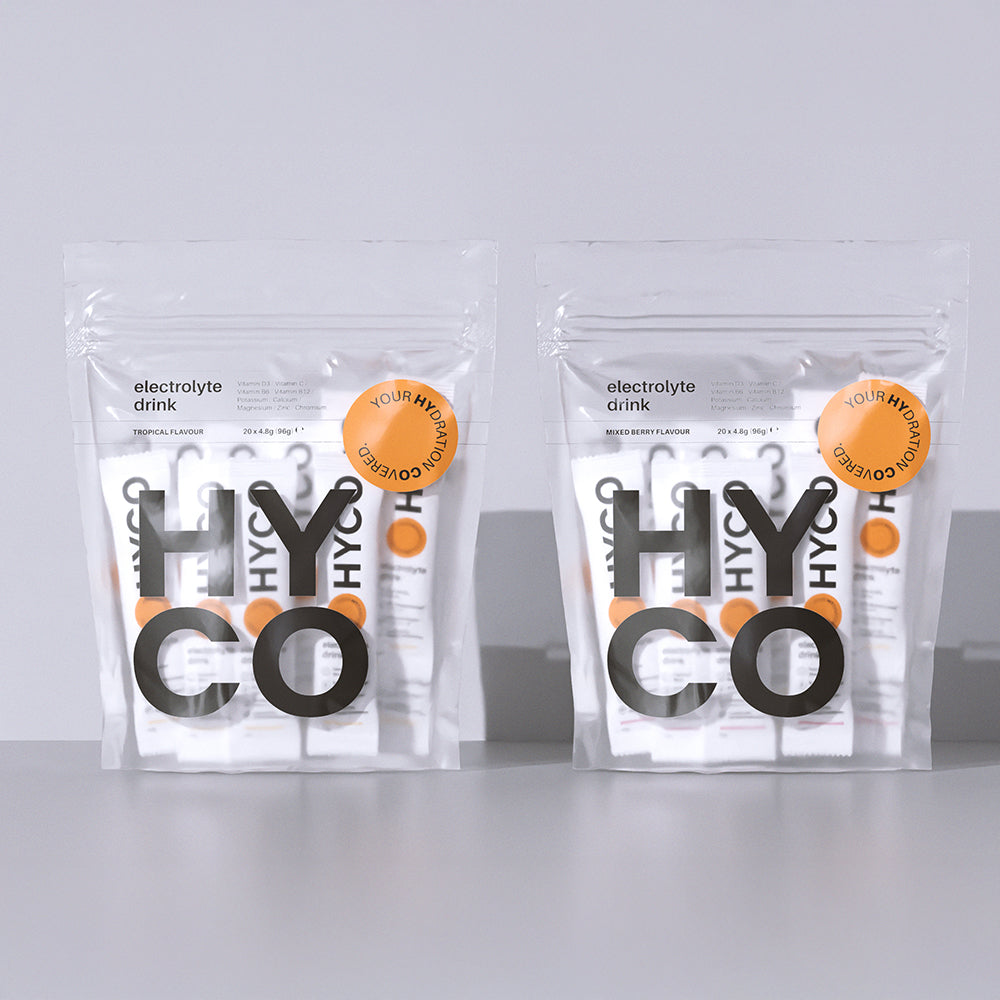
Two pouches of twenty, in whichever combination you like: one of each flavour, or two of your favourite. About a month at one sachet a day. If you've found your flavour, the HYCO Double Pouch with 40 electrolyte sachets is the better price per serving.
Electrolyte Powder Without Stevia: What the Unsweetened and Unflavoured Options Actually Taste Like
Electrolyte powder without stevia exists, and it is often unflavoured.
The taste is the trade-off. Sodium is salt. A drink with 250mg of sodium and nothing to soften it tastes savoury, not sweet. Some people love that; most don't finish the glass.
Here's the practical split we'd draw:
- Unsweetened and unflavoured: best if you add it to a smoothie, juice or flavoured drink where you won't notice it.
- Sweetened with stevia: best if you want to drink it as water, straight from the glass.
- Sweetened with monk fruit: a similar natural option, though less common in sachet form.
If you want a drink you'll actually reach for mid-afternoon, stevia-sweetened is the realistic choice. If you want zero sweetener of any kind, go unflavoured and mix it into something else.
Electrolyte Powder With No Sweeteners: How to Read the Ingredients List
Turn the pack over and read the ingredients in order. Ingredients are listed by weight, so the first few names tell you most of what you need to know.
Use this checklist:
- Check the sweetener line. Look for stevia, erythritol, monk fruit or sucralose. If you see sucralose, acesulfame K or aspartame, that's an artificial sweetener.
- Check for sugar under other names. Dextrose, maltodextrin, glucose syrup and fructose all count as sugar or sugar-adjacent.
- Check the sodium figure in milligrams. Anything vague like "electrolyte blend" without numbers is a red flag.
- Check the serving size. A dose per 250ml versus per 500ml changes the real cost and the real mineral intake.
- Check the calorie line. Zero calorie and low calorie are not the same claim.
If you want to confirm exactly what's in HYCO, how much water each sachet needs, and whether it contains sugar or caffeine, the HYCO FAQs answer those directly.
Sugar-Free Electrolyte Powder: Sweetener Types, Calories and Carbohydrates Compared
Sugar-free electrolyte powder replaces sugar with a sweetener, and the type matters more than the word "free". But "artificial" is not a legally defined term on UK food labels, so the only way to apply your own definition is to know what each sweetener actually is and where it comes from.
Artificial sweeteners are synthetic. On a label, look for sucralose (E955), aspartame (E951), acesulfame K (E950) and saccharin (E954). They are common because they are cheap and intensely sweet, sucralose is roughly 600 times sweeter than sugar, which is why a tiny amount does the job.
Natural sweeteners come from plants. Stevia leaf extract (E960) is derived from the leaves of Stevia rebaudiana. Monk fruit extract (often listed as luo han guo) comes from a small green melon and is similarly intense. Both are calorie-free and widely used in sugar-free drinks.
Processed sweeteners sit in between. Erythritol (E968) is a sugar alcohol made by fermenting glucose with yeast. It occurs naturally in fruit, but the commercial product is manufactured. It is calorie-free, about 70% as sweet as sugar, and often blended with stevia to soften stevia's slight aftertaste.
Unsweetened means no sweetener at all, natural or artificial. The taste is savoury, because sodium is salt. Some people add a squeeze of lemon or a dash of juice; others mix the powder into a smoothie or flavoured drink where the salt is masked.
On calories and carbohydrates, a zero-calorie sachet contributes nothing meaningful to your daily intake. For the actual per-serving calorie, carb and sugar figures, the Mixed Berries and Tropical nutrition breakdown lists them in full.
The practical point: stevia and erythritol are not artificial. If your goal is avoiding artificial sweeteners, a stevia-sweetened powder clears that bar. If your goal is avoiding all processed sweeteners, you need to go unsweetened, and accept the salty taste.
Electrolytes Without Sugar: Matching Sodium, Potassium and Magnesium to Your Day
A desk worker and an endurance athlete don't need the same sodium, and the difference is not marginal.
Here is how we would match the three main electrolytes to common scenarios. The figures are typical daily needs from food and drink combined, not supplement targets; use them to judge whether a powder is adding meaningfully to your intake.
| Use Case | Sodium Need | Potassium Need | Magnesium Need | When to Drink |
|---|---|---|---|---|
| Office afternoon slump | Low-moderate (under 500mg) | Low (under 500mg) | Low | Early afternoon, in place of a coffee |
| Daily hydration routine | Moderate (500-1,000mg) | Moderate (500-1,000mg) | Low-moderate | One sachet, morning or midday |
| Gym session under an hour | Moderate (500-1,000mg) | Moderate | Low | Before or during |
| Endurance training (1-3 hours) | Higher (1,000-2,000mg) | Higher (1,000-1,500mg) | Moderate | During and after |
| Hot weather or heavy sweating | Higher (1,500-3,000mg) | Higher | Moderate | Through the day |
HYCO delivers 250mg of sodium per sachet, alongside potassium, magnesium, calcium, zinc and chromium. If you are sweating heavily for hours, you will want more sodium than a single daily sachet provides, either a second sachet or a product formulated for endurance use.
A common pattern is to treat electrolyte powder as a replacement for all fluid loss. It is not. For sessions under an hour, water and a normal diet usually cover your needs. If you are unsure why sodium matters in the first place, read why salt isn't bad for you when used properly.
Watch out: if you have kidney disease, high blood pressure, or take diuretics or blood-pressure medication, do not increase sodium or potassium intake without speaking to your GP. Check with your doctor before changing your electrolyte intake if you have a medical condition.
Most people don't need a cabinet full of powders. They need one they'll actually drink, at a dose that fits their day, with a label they can read without a chemistry degree. Start with the Taster Pack, settle on your flavour, then move to the Double Pouch for the best price per serving. Every HYCO sachet is sugar-free, caffeine-free and sweetened with stevia and erythritol, with 250mg of sodium plus vitamins C, D3, B5, B6 and B12, lab-tested and made in the UK.
Frequently Asked Questions
What is the best electrolyte powder without artificial sweeteners?
There is no single winner, because the right pick depends on whether you want stevia, erythritol or nothing sweet at all. Check three things before buying: the sweetener named on the label, the sodium per serving (250mg is a sensible daily baseline), and the cost per sachet. HYCO is sweetened with stevia and erythritol, with 250mg sodium per sachet and no sugar, calories or caffeine. Its Taster Pack at £27.00 includes both flavours.
Which electrolyte powders do not contain stevia?
Plenty of brands sweeten with stevia, so if you want an electrolyte powder without stevia you have two routes. The first is a genuinely unsweetened, unflavoured powder, which tastes salty and mineral-heavy in water. The second is a product sweetened with something else, such as erythritol alone or monk fruit. Read the ingredients panel rather than the front of the pack, because 'naturally sweetened' tells you nothing about which plant extract is inside.
Are electrolyte powders without artificial sweeteners also sugar-free?
Not automatically. A powder can avoid sucralose and acesulfame K while still containing glucose, dextrose or cane sugar for taste and absorption. Sugar-free electrolyte powder will list zero or near-zero carbohydrates and no sugar in the nutrition table. Check both panels: the ingredients list for sweetener names, and the nutrition table for grams of sugar and total calories per serving.
Can you get electrolyte powder with no sweeteners at all?
Yes. Unflavoured, unsweetened electrolyte powder exists and typically contains only mineral salts, sometimes with an acidity regulator. The trade-off is taste: without any sweetener the saltiness is obvious, so many people use a smaller scoop in more water. Flavoured options almost always need something sweet to carry the flavour.
Are sugar-free electrolyte powders suitable for daily use?
Keep an eye on total sodium across your whole diet, and check with your GP first if you have kidney disease, high blood pressure or take diuretics. Sugar alcohols such as erythritol can cause loose stools in some people at higher doses, so start with one sachet.
